
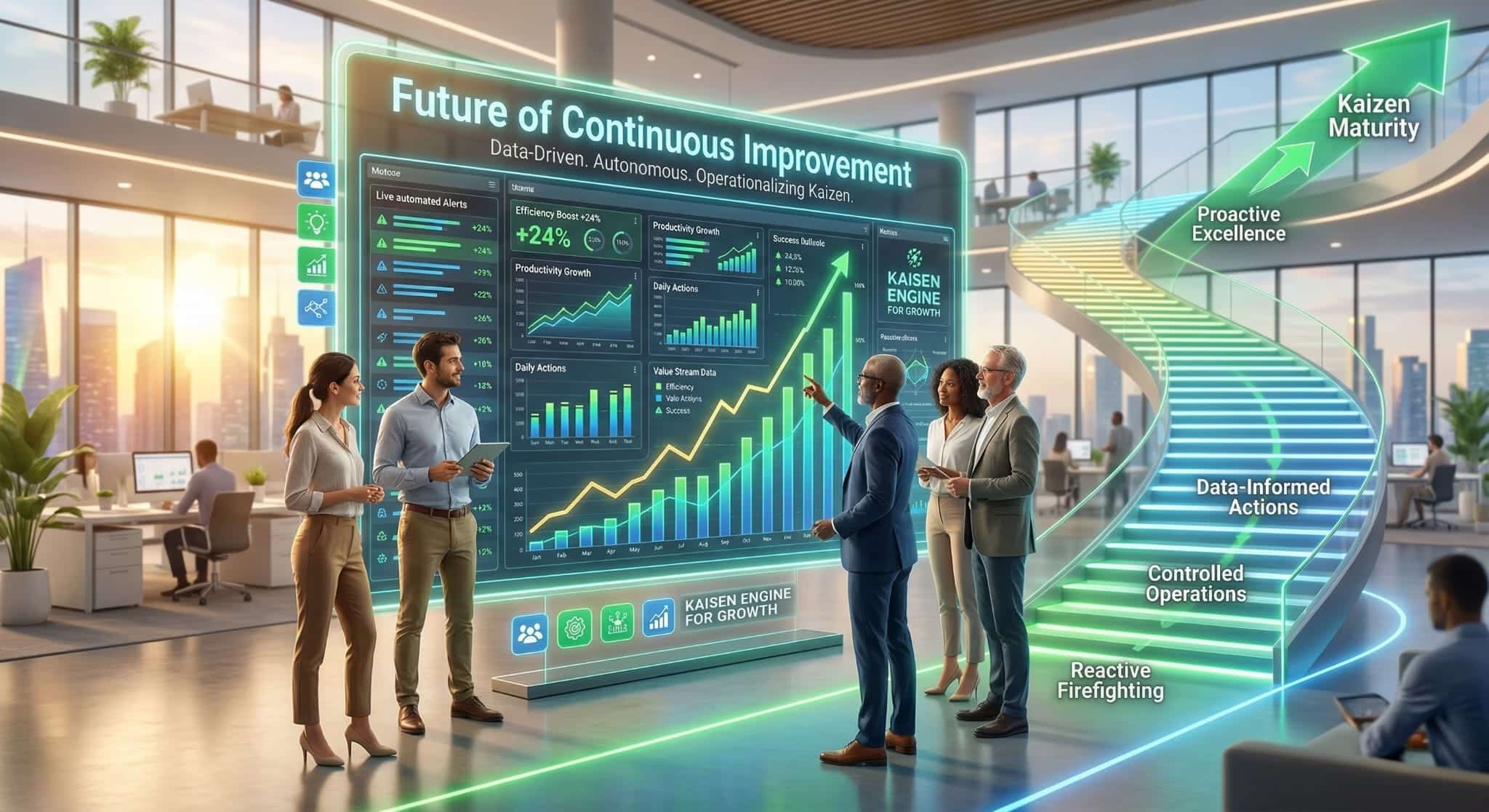
How do you go from being a continuous improvement professional waiting for someone to assign you a project to building a system that automatically triggers lean activities based on actual business needs? For many organizations, the ultimate goal of continuous improvement (CI) is to move away from a push model, where experts walk the floor trying to find where to launch a project, and move toward an ingrained culture. The pinnacle of this culture is an environment where everybody comes to work every day asking themselves, “What is the most important thing or what improvement can I make today within my scope of responsibility?”.
This transition represents the essence of operationalizing Kaizen: integrating continuous improvement seamlessly into the daily flow of work rather than treating it as an episodic, ad-hoc initiative. Below, we will explore the core concepts necessary to achieve this, from crafting the right messaging and understanding where your organization sits on the CI maturity spectrum, to the specific techniques required to make Kaizen a daily operational reality.
The Messaging Matters: Lean as a Tool for Growth, Not Job Cuts
One of the first and biggest mistakes companies make when beginning a lean journey is positioning the initiative strictly around cost reduction. When lean is pitched primarily as a way to cut costs, employees inevitably translate that to mean management is coming for their jobs. This fear is so prevalent that in some organizations, “lean” has been cynically redefined by the workforce as an acronym for “less employees are needed”.
To build a sustainable CI culture, leaders must completely flip this narrative. The fundamental assumption and message must be that the company is not looking to cut jobs in the long term. Instead, lean must be positioned as a powerful vehicle for growth, capacity building, and market expansion. It should be communicated as a strategy that will make jobs easier and create new opportunities for the people who work there.
A better-run, highly efficient business will inherently win more customers. With that market success and organizational growth, employees will have expanded opportunities to advance within the business. While natural attrition will always occur, lean should never be positioned as the mechanism to eliminate staff. Leaders must avoid starting the conversation with job cuts or cost reductions, and instead strictly focus the messaging on growth, opportunity, and expansion. Only when the workforce feels secure can they truly embrace the vulnerability required to expose flaws and improve processes.
Understanding the Continuous Improvement Maturity Range
To operationalize Kaizen, an organization must first understand its current maturity level. Companies exhibit a full spectrum of maturity when it comes to lean culture, which dictates how CI activity is initiated.
- Level 1: Crisis-Driven (The Lowest Maturity). At the least mature end of the spectrum, lean activity is entirely reactive. Projects are only triggered when there is an absolute crisis – someone is terrified, leadership is angry, or a massive failure has occurred. This relies on “post-mortem” reviews to develop changes after something has already gone wrong. Attaching lean’s brand to this constant firefighting is highly toxic.
- Level 2: Quota-Driven. Moving slightly up the maturity scale, companies might hire a dedicated lean manager or director and simply assign them a quota, such as completing six to twelve Kaizen events per year. The lean resource must figure out how to hit this target within their 40-hour week. While this generates activity, it often lacks deep commitment from operations leaders, meaning the CI manager can only push the organization as fast as it is willing to go. Furthermore, setting workshop quotas can lead to “check the box activity,” driving the wrong behaviors where workshops focus on simple clean-up rather than meaningful systemic improvement.
- Level 3: Strategy Deployment. At this stage, employees and managers collaborate to commit to three to six specific goals for the calendar year. While enthusiastic at first, employees typically fall right back into “business as usual,” managing daily crises, and leaders simply hope the metrics improve by the end of the year. This approach lacks the routine, day-to-day operational triggers necessary for world-class lean.
- Level 4: Calendarized Events. A more operationalized approach utilizes the calendar to push lean activity, much like businesses use the calendar to schedule standard production shifts. This might involve a facility-wide 5S audit on the first of every month, a quarterly lean program review, or establishing priorities for specific production cells based on metrics like scrap or on-time delivery. Leadership standard work often relies on these calendarized routines to ensure lean boxes are being checked.
- Level 5: Data-Driven Routine. At the highest level of maturity, lean activity is triggered routinely and autonomously by actual data. In this healthy, pull-based model, teams review day-to-day or even hour-to-hour metrics to spot opportunities and trigger immediate action. It shifts the paradigm from “hunting and gathering” for problems to “farming a kaizen culture”.
Techniques for Operationalizing Kaizen
Moving an organization up this maturity spectrum requires deliberate strategies. Instead of hoping for improvement, leaders must engineer an environment where continuous improvement is inevitable.
1. The “Crawl, Walk, Run” Approach to Training A successful lean journey must begin with foundational education; you cannot expect people to behave differently if they have not been shown what excellence looks like. Implementing a “crawl, walk, run” approach ensures staff receives basic knowledge before advanced concepts are introduced. A structured certification program is highly effective for this.
- White Belt: Provides a general, philosophical overview of lean and six sigma, exploring their origins and foundational concepts like standard work.
- Yellow Belt: Teaches basic tools that can be applied immediately outside of large projects, such as the five whys and fishbone diagrams.
- Green & Black Belts: Introduces advanced project management tools for area or department-level initiatives.
- Master Black Belt: Focuses on enterprise-level strategic development and execution.
2. Do It “With Them,” Not “To Them” A critical factor in operationalizing Kaizen is ensuring that improvement initiatives are done with the teams, so they take true ownership. If CI professionals simply impose projects on a department, the efforts will fail miserably. During workshops, the front-line employees must own the solutions, run the meetings, and drive the implementation. CI leaders should merely orchestrate and support, ensuring the employees are the ones generating the ideas and writing the action items, which guarantees better project success and sustainability.
3. Implement Routine-Based Triggers and Tier Boards To prevent lean momentum from fading over time, organizations must establish routines that serve as automatic triggers for activity. This is often accomplished through a tiered meeting structure combined with visual management.
- Tier 1 (The Gemba): Daily walks around the production or operational area to review visual boards. Metrics are typically color-coded. Green means all is well, yellow requires monitoring, and red triggers immediate corrective action, such as a root cause analysis or an A3 project.
- Tier 2: Held every 24 hours, where managers and leaders review the past day’s performance and escalate issues.
- Tier 3: Executive leaders gain visibility into the shop floor to understand what corrective actions and lean projects need to be initiated strategically.
4. Establish 5S Before Advanced Visual Management While tier boards are excellent tools, they should not be the first step in a lean rollout. Implementing complex tracking boards without a foundational culture often turns them into an ignored “check the box” activity. Organizations should prioritize a robust 5S system first. This helps drive initial improvement efforts by identifying waste and establishing basic organization. Staff must understand 5S as a comprehensive operating system, not just a cleaning exercise, before introducing boards to monitor progress.
5. Measure Culture, Not Just Dollar Savings Tracking the success of a lean program strictly by financial savings is a trap. Tying CI directly to dollar amounts drives the wrong behavior and can actually cause improvement efforts to stagnate. Instead, organizations should measure how sites are moving up the lean maturity continuum. Standardized audits can act as checks and balances, defining what excellence looks like and triggering further improvement when cultural or operational gaps are identified.
6. Use Data to Spark Activity Across All Departments Continuous improvement efforts must be grounded in data to establish baselines and measure real progress. While immature organizations might launch projects based on anecdotal feelings or “whoever is screaming the loudest,” mature organizations use data daily to pinpoint efficiency gaps. Crucially, lean is not just for manufacturing. Many non-manufacturing sectors mistakenly believe Kaizen is only for the shop floor. However, massive waste often exists in back-office functions like HR, finance, and engineering. Tools like the Balanced Scorecard are highly effective in non-manufacturing settings to align CI efforts with overarching business goals, customer needs, and internal process metrics.
The Future: Autonomous Kaizen
For decades, the lean movement lagged behind other business functions in technology adoption. While sales, marketing, and quality departments adopted advanced software, lean professionals often relied on manual, analog methods. That era is ending.
The future of operationalizing Kaizen lies in leveraging the massive oceans of data companies already possess. Soon, artificial intelligence and big data analytics will automatically expose operational issues and autonomously prompt lean activities. A human gatekeeper will simply review the system’s prompt, confirm the need, and automatically trigger a Kaizen event assigned to a properly certified employee. By combining structured training, routine triggers, positive growth-focused messaging, and modern data systems, organizations can build a scalable, highly advanced approach to continuous improvement that guarantees they get better every single day.
Frequently Asked Questions (FAQ): Operationalizing Kaizen with Lean Management Software
1. How can lean management software help transition our company from reactive firefighting to proactive continuous improvement? Many organizations struggle with continuous improvement because they rely on a “push model,” where lean professionals walk the floor looking for problems or wait for a crisis to occur before taking action. Lean management software shifts this paradigm by building data systems that automatically trigger tools, projects, and lean activities based on real, day-to-day business needs. How Impruver approaches this: The Impruver system integrates directly with your Business Intelligence (BI) and data systems. Instead of waiting for a failure, Impruver monitors this data to automatically expose operational opportunities, helping you build a healthy, pull-based demand for lean activity and allowing your team to “farm a Kaizen culture” rather than constantly hunting for problems.
2. Does implementing continuous improvement software remove the need for human leadership and decision-making? No, modern lean software is designed to augment human intelligence, not replace it. While the software can analyze data to find opportunities, the actual improvement work requires locking arms with operations and having front-line teams take ownership of the solutions. How Impruver approaches this: Impruver utilizes advanced tools like artificial intelligence and big data analysis to prompt potential lean activities autonomously, but it specifically maintains a “human in the loop”. A human gatekeeper always reviews the system’s prompts to confirm whether the suggested activity makes sense before approving it, clicking a button, and officially triggering the work.
3. How does software ensure that the right people are assigned to the right improvement projects? Assigning complex problems to untrained staff often leads to failure, while assigning simple tasks to highly trained lean experts is a waste of resources. How Impruver approaches this: Impruver addresses this by integrating a structured Lean Six Sigma certification program (ranging from White Belt to Master Black Belt) directly into its ecosystem. When the Impruver system exposes an issue and the human gatekeeper approves the Kaizen event, the software automatically triggers and assigns the work to an employee who has been certified up to the appropriate level to sufficiently address that specific issue.
4. We already have massive amounts of data in SQL databases and PowerBI. Can lean management software utilize this? Historically, the continuous improvement world fell behind other departments (like sales, marketing, and quality) because lean consultants insisted on keeping everything manual and analog. However, mature organizations understand that they are sitting on oceans of data that can be used to pinpoint efficiency gaps. How Impruver approaches this: Impruver is built specifically to capitalize on the hordes of data your company already possesses. By connecting to existing data streams, Impruver gives CI professionals the same level of automated visibility and app-based tracking that other modern business professionals enjoy, bridging the gap between legacy lean methods and modern technology.
5. What is required to truly scale our continuous improvement efforts across the entire enterprise using software? Scaling continuous improvement requires more than just a digital suggestion box; it demands a systematic way to build discipline, manage routines, and execute Kaizen. How Impruver approaches this: Impruver operates as a comprehensive scaling software platform that provides “the tools, the tech, the team, and the training”. By combining hands-on coaching and structured training with a systematic, tech-driven way of managing Kaizen, Impruver delivers a highly scalable approach to continuous improvement that goes beyond what manual methods have achieved over the past few decades.
