
Primary Challenge
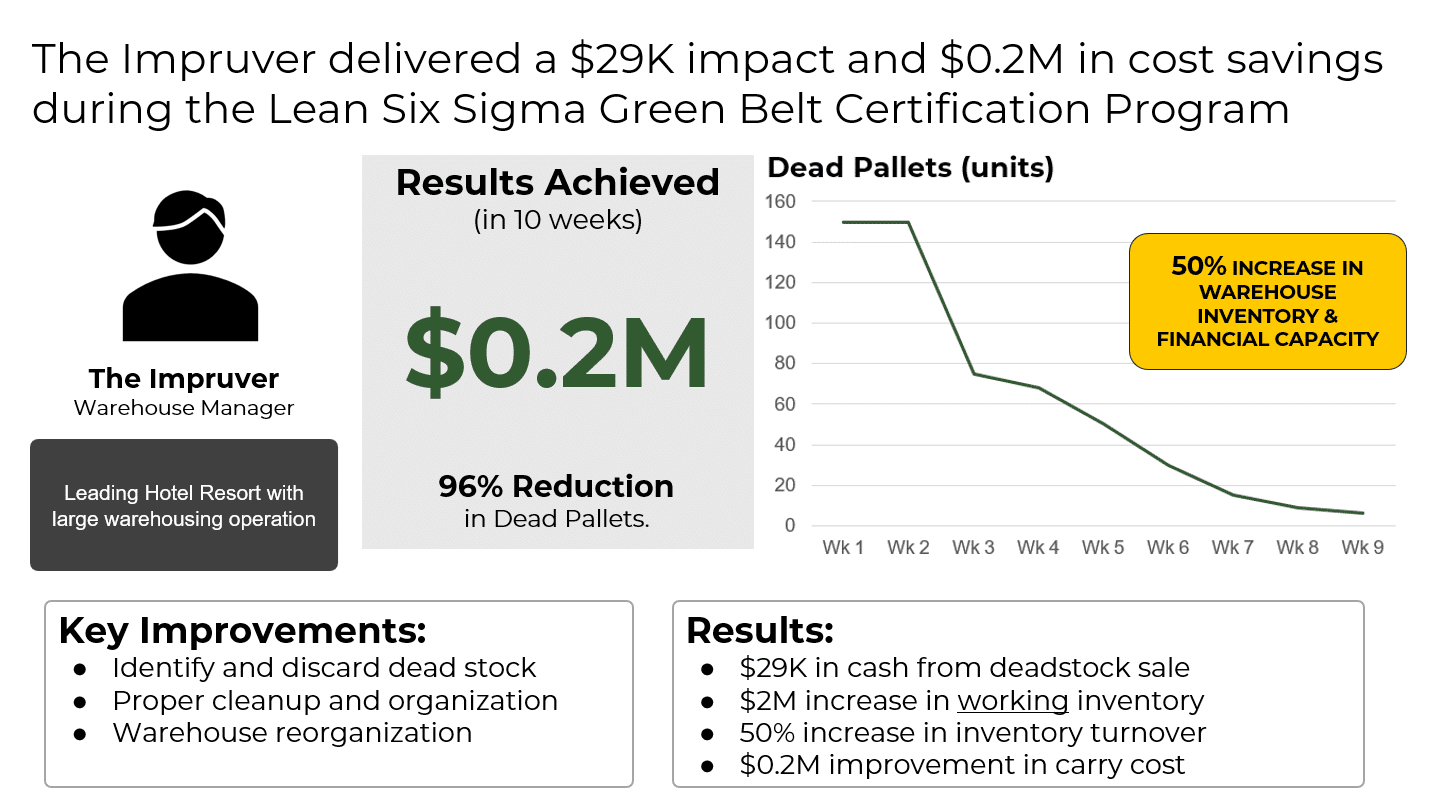
The facility faced a significant operational bottleneck caused by a massive accumulation of dead stock, which occupied critical floor space and hindered operational flow. Prior to the project, the warehouse was burdened with approximately 200 pallets of dead stock, leading to high carrying costs and restricted inventory capacity.
Broader Industry Issue
This challenge reflects a common supply chain and warehousing struggle: inventory stagnation. Without regular audits and lean organizational practices, warehouses often fall victim to “hidden waste,” where obsolete materials consume the financial and physical capacity needed for high-demand, revenue-generating inventory.
Financial Impact (Cost of Inaction)
The lack of a structured inventory management system resulted in substantial trapped capital and unnecessary overhead:
- Inventory Carry Costs: The inefficient management of stock contributed to an estimated $0.2M in avoidable carry costs.
- Trapped Capital: Large volumes of dead stock prevented the conversion of obsolete items into liquid cash.
- Capacity Loss: The warehouse suffered from a lack of “working inventory” space, limiting the facility’s ability to scale operations.
Metric Impacted & Results
In just 10 weeks, the Lean Six Sigma Green Belt initiative delivered the following results:
- Dead Pallet Reduction: Achieved a 96% reduction in dead pallets (dropping from 200 units to just 6).
- Inventory Capacity: Realized a 50% increase in warehouse inventory and financial capacity.
- Inventory Turnover: Increased inventory turnover by 50%.
- Cash Recovery: Generated $29K in cash through a successful dead stock tent sale.
- Total Financial Impact: Delivered $0.2M in cost savings and a $2M increase in working inventory.
Key Improvements
The success of the project was driven by three tactical shifts in warehouse management:
- Systematic Dead Stock Elimination: Identifying and discarding obsolete items through a planned “tent sale” to recover costs and clear space.
- Strategic Space Reorganization: Assessing best space utilization to improve efficiency and flow, moving from a cluttered environment to an organized layout.
- Standardized Labeling & Demand-Based Slotting: Organizing products by brand, location, and demand while implementing clear labeling and safety protocols.
Other Implications
Beyond the immediate financial gains, the project fostered several cultural and secondary benefits:
Cultural Shift: The project demonstrated the efficacy of Lean Six Sigma methodologies within the Bahamar team, establishing a blueprint for future continuous improvement projects.
Improved Safety: Enhanced labeling and organization reduced the hazards associated with a cluttered warehouse environment.
Operational Visibility: The transition to demand-based organization allowed for better real-time tracking and faster retrieval times.
Improvement Methods Applied: The project leader completed this assignment as part of his Impruver University Lean Six Sigma Green Belt Certification program. He applied PDCA via the Impruver Storyboard, Spaghetti Diagram and Fishbone Analysis.
