
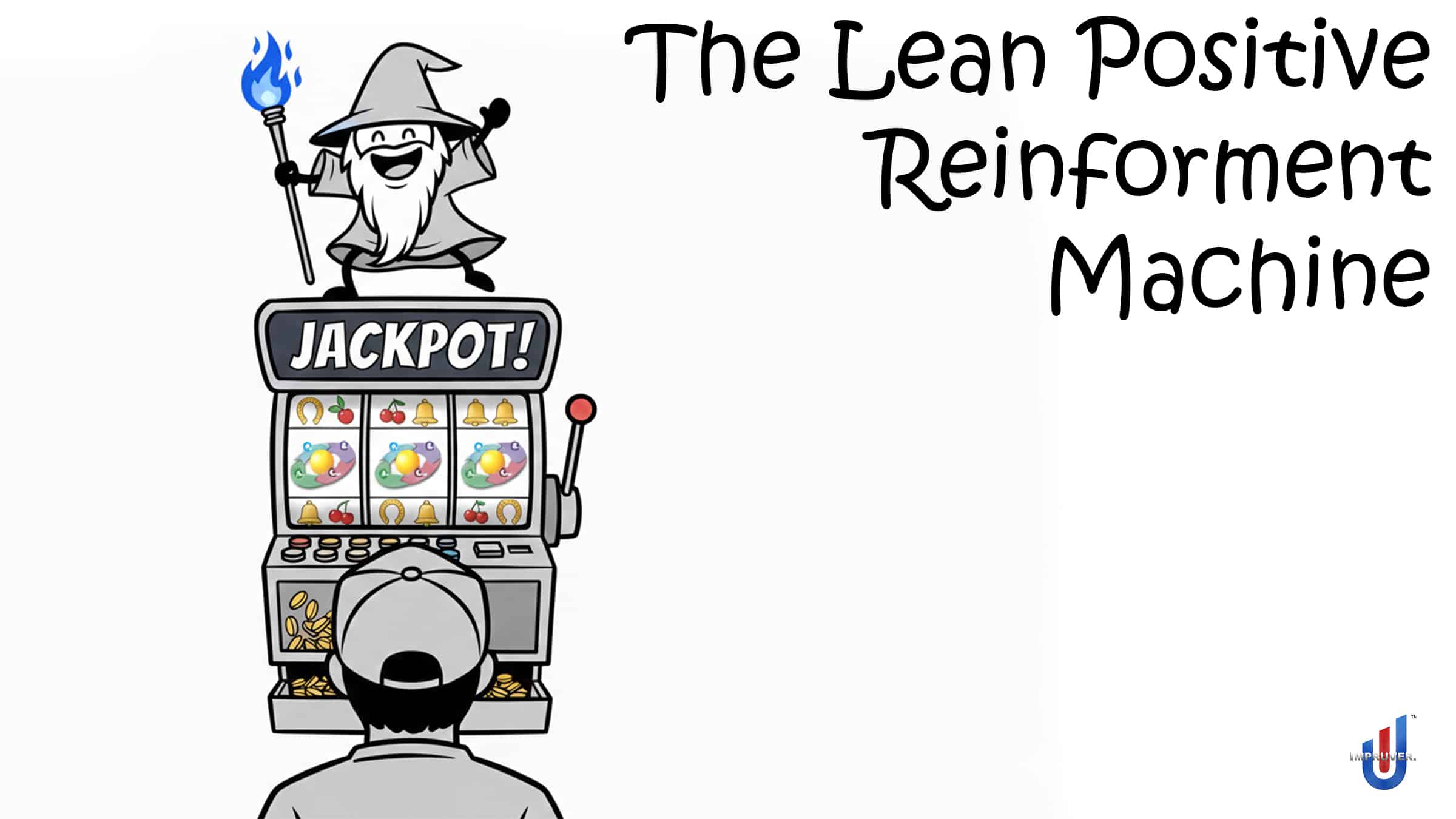
For decades, we have approached Continuous Improvement (CI) as a technical challenge. We have treated it as a management problem to be solved through rigid methodologies—5S audits, Value Stream Mapping, and KPI boards. However, a critical examination of failing Lean initiatives reveals a consistent, uncomfortable truth: we have turned one of the most dynamic aspects of business into a sterile, bureaucratic exercise.
We treat Continuous Improvement like a math problem. But the most important variables in that equation are human beings. And humans do not run on logic; we run on neurochemistry—specifically, dopamine .
If your organization struggles to maintain momentum in its Kaizen culture, the issue likely isn’t a lack of discipline. It is a fundamental misunderstanding of human motivation. To build a culture of excellence, we must stop managing for robots and start designing for biology.
The Structural Flaw: The Gratification Gap
In behavioral economics, the timing of a reward is often just as critical as the reward itself. Video games and sports addict us because the feedback loop is immediate: action yields an instant result. We start to crave the dopamine kick that comes with scoring a goal, so we shoot more shots. We fantasize about it. We imagine what we will do once we get it. We imagine ourselves happier and admired by those around us.
Contrast this with the traditional corporate structure. An employee invests significant mental energy in a Kaizen event or Root Cause Analysis in Q1, but the recognition – if it comes at all – is delayed until a quarterly review or an annual bonus.
This delay creates a “Gratification Gap” . When the feedback loop is stretched over months, the brain decouples the effort of improvement from the reward of success. The work becomes a cost, and the benefit becomes abstract. Consequently, Lean is viewed not as an opportunity for growth, but as an administrative tax on actual work. Instead, our time is consumed pursuing activities that produce more immediate ROI; and unfortunately, many of those activities do not lead to long-term prosperity or Continuous Improvement.
Compliance vs. Commitment
Faced with this engagement drop-off, leadership often defaults to two archaic levers: financial incentives and fear.
While fear – manifested as the threat of a “red box” on an audit – can produce results, it produces the wrong kind of results. Fear creates a culture of compliance . In a compliance culture, employees do the bare minimum required to avoid negative consequences. They are not thriving; they are surviving.
To achieve operational excellence, we require commitment—an intrinsic drive to exceed standards because the act of improvement itself provides satisfaction. This intrinsic drive for improvement needs to overpower the extrinsic pressure to maintain the status quo. With any improvement, someone’s cheese is moved, and therefore not changing anything is the safer path in traditional organizations. The challenge for us Lean leaders is to make Continuous Improvement the easiest path to take.
Architecting Engagement: The Principles of “Lean Dopamine”
To close the Gratification Gap, we must look to the principles of gamification. This is not about trivializing work; it is about aligning operational processes with the psychological needs for Autonomy, Mastery, and Purpose.
1. From Assignment to Autonomy Traditional management assigns tasks. High-performance cultures offer choices. By presenting known issues as a “quest log” rather than a “to-do list,” we shift the psychological framework from obligation to ownership .
2. Visualizing Mastery Competence is a primary motivator. Yet, in most plants, skill acquisition is invisible. By structuring training as a “leveling up” process – where employees can track their progress toward “Level 3 Fabricator” or “Safety Lead” – we utilize the desire for status and achievement to drive upskilling .
3. The “Co-Op” Imperative Business is inherently a team sport, yet our reward systems are often individualistic. Rewarding the “person with the best idea” creates silos and incentivizes knowledge hoarding. Instead, we must adopt a “co-op mode” mentality. When rewards are tied to collective metrics – where the whole team wins only when the cell hits its target—peer pressure transforms into peer support.
The Scalability Problem: Why Technology is Essential
The psychological framework for “Lean Dopamine” is sound, but the execution presents a logistical barrier. Manually tracking “experience points,” managing team rewards, and updating visual scoreboards for hundreds of employees creates a massive administrative burden. When the friction of managing the system outweighs the benefits, the program collapses.
This is where technology shifts from a convenience to a necessity.
To scale a gamified Continuous Improvement culture, you need a digital infrastructure that democratizes the data. Technology automates the feedback loop, ensuring that the dopamine hit – the recognition of a job well done – arrives the moment the task is completed, not weeks later. It provides the transparency needed to turn isolated wins into organizational momentum.
🎮 The Lean Gamification ROI Calculator
Estimate the revenue trapped in your “Gratification Gap.”
(Employees doing “just enough” to avoid a red box on the audit)
50%(Gain from stopping idea hoarding and starting team collaboration)
Operationalizing the Strategy with Impruver
For leaders seeking to modernize their CI infrastructure, Impruver offers a purpose-built solution.
Impruver is not merely a tracking tool; it is a behavioral engine designed to bridge the gap between intent and execution. It operationalizes the concept of “Lean Dopamine” by creating a digital ecosystem where improvement activities generate tangible value – an “Impruver Bank Account” for your workforce.
By automating the mechanics of gamification – tracking skill progression, managing team challenges, and distributing rewards – Impruver allows leadership to step back from the spreadsheet and focus on the strategy. It moves the organization away from the adversarial “poke with a stick” management style toward a collaborative, high-performance arena.
Conclusion
The difference between a stagnant facility and a world-class operation is rarely the quality of their charts or the sophistication of their machinery. It is the chemistry of their culture.
We cannot continue to demand robot-like consistency from biological beings. We must build systems that reward the behaviors we seek to cultivate. Whether through manual restructuring or by leveraging platforms like Impruver, the mandate is clear: Stop managing for compliance. Start leading for commitment.
While manual tools are a good starting point, they are difficult to scale and often fail to bridge the “Gratification Gap.” Manual tracking requires significant administrative effort to maintain, and rewards are often delayed by months. Software like Impruver automates the feedback loop, providing instant recognition and “dopamine hits” that manual spreadsheets cannot, ensuring that the act of improvement feels as good as the result.
If a platform focuses solely on audits and “red boxes,” it creates a culture of compliance (fear-based), not commitment. To actually improve culture, you should look for software that includes a gamification engine. This shifts the motivation from extrinsic fear to intrinsic satisfaction by fulfilling human needs for autonomy, mastery, and purpose.
Impruver moves beyond simple “employee of the month” recognition. The platform features an “Impruver Bank Account” where employees generate digital tokens for specific improvement activities—such as fixing a problem, completing a project, or hitting a goal. These tokens can then be traded for individual or team-based rewards, effectively automating the positive reinforcement loop.
It can if the software is designed poorly. A common mistake is rewarding individuals solely for the quantity of ideas, which creates silos. Effective Lean software such as Impruver supports “Co-op Mode,” where rewards are tied to team performance (e.g., the whole team hitting a target). This ensures that employees work together to defeat waste rather than competing against each other.
Manual gamification (tracking points, updating leaderboards) is very time-consuming. Impruver is designed specifically for leaders who “don’t have time to do all this manually.” It handles the tracking, token generation, and skill progression automatically, allowing you to focus on leading the strategy rather than managing the spreadsheet.
