

In the world of Continuous Improvement (CI) and Lean, Toyota is the gold standard. They have essentially “hacked” people development better than anyone else, embedding scientific thinking into the very DNA of their organization. For decades, Western companies have tried to copy their tools—Kanban, 5S, Standard Work—but often fail to replicate their results.
Why? Because while American and other capitalistic economies often look for growth primarily through capital deployment and acquisition, Toyota focuses on operational excellence and people development. They understand that business performance is driven by coaching, much like how a Michael Jordan or Kobe Bryant never reaches their peak without a Phil Jackson.
But here is the hard truth: trying to replicate Toyota’s manual coaching structure is economically impossible for most companies. However, there is a new way to not only catch up to Toyota but potentially outperform them. It requires shifting our approach to Lean Knowledge Management and leveraging the power of technologies like Artificial Intelligence.
The Economics of Coaching: Why We Can’t Just “Hire More Coaches”
If you look at the economics of traditional coaching, it is practically social work. It requires a high degree of expertise, takes a long time to show results, and is expensive.
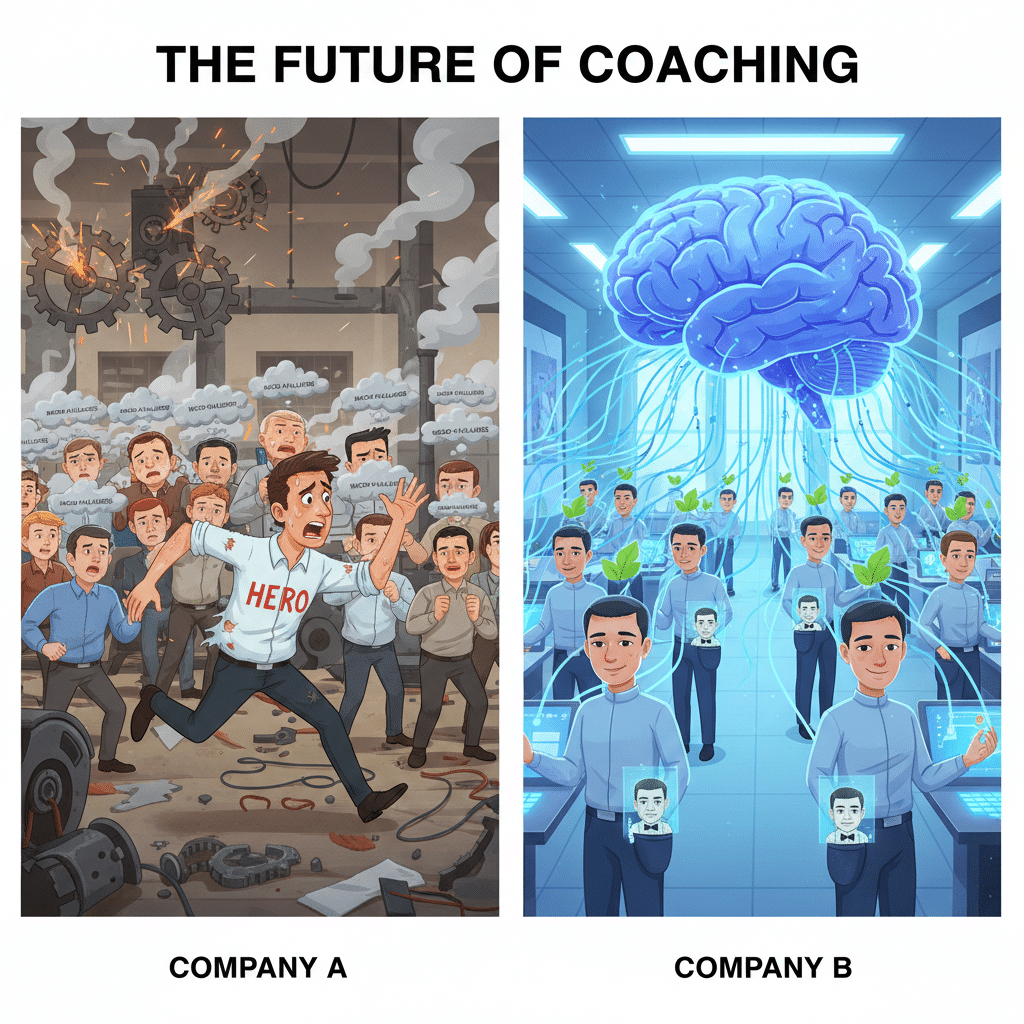
This creates the “Hero Coach” problem. In any given company, perhaps a few executives can afford personal coaches, but the middle managers and frontline employees – the ones actually creating value – are left behind. Even hiring a dedicated Continuous Improvement manager to serve as ‘general CI coach’ doesn’t begin to satisfy the need for the entire organization.
To make matters worse, because coaching is so scarce, it often develops a bad reputation. In many organizations, coaching is viewed as a form of punishment or a “mark of shame”. It becomes a reactive tool used only when someone is failing, often as a documentation step before a termination or a Performance Improvement Plan (PIP). This is the exact opposite of what coaching should be: consistent, proactive, and progressive.
The Three Paths to Scaling
So, how do we solve this? If we agree that every single player on the team needs a coach to win, we are left with three options.
Option A: The Army of Experts You could go out and hire an army of CI coaches. The pro is that you get “white glove treatment” for your staff. The con is that it is so expensive it is not even practical for most businesses.
Option B: The Toyota Structure You could restructure your entire company to match Toyota’s model, which often aims for a 1:6 manager-to-direct-report ratio. In this model, leaders are expected to be the coaches and spend a significant amount of time developing their people. While this is ideal, especially since it creates a conduit to cascade strategic priorities, it is incredibly difficult to build and sustain. It relies on human behavior, which is inherently inconsistent, and it takes years to develop leaders who are actually capable of effective coaching.
Option C: The “Super Brain” (AI) This brings us to the larger discussion of Lean Knowledge Management: leveraging technology to bridge the gap.
Taiichi Ohno in Your Pocket
Imagine if every individual in your company had Taiichi Ohno (the father of the Toyota Production System) in their pocket. But not just the historical Taiichi – a version that is an expert on your company, your SOPs, and your real-time data.
By using AI, we can create a “super brain” that offers benefits human coaches simply cannot match at scale:
- Total Knowledge Retention: The AI knows what happened last month, last week, and today without needing to pull reports, because it is tapped into existing data sources.
- Instant Resource Sharing: It can connect best practices across the organization instantly. If a team in one plant solves a problem, the AI can suggest that solution to a team in another plant, or even book a meeting between the two parties.
- Consistent Motivation: Just like a human coach, AI can help set goals, prompt you when you are skipping PDCA cycles, and offer course correction when you drift off track.
This is the ultimate evolution of Lean Knowledge Management. It isn’t just about storing documents; it is about an active, connected intelligence that develops talent 24/7. This is what enables you to scale Continuous Improvement throughout your organization.
The Prediction: Company A vs. Company B
Let’s look at two hypothetical organizations.
Company A is traditional. They use the old-school way where coaching is rare and often used to “out counsel” people or justify firing them.
Company B takes coaching seriously. They have provided every single person in the company with a coach via this AI “super brain”. Even when the human manager is busy, the employee receives high-quality, data-driven guidance.
When you put their products side-by-side on a shelf, the difference will be obvious. The people development advantage at Company B will show up in the quality of the product, the customer service, and the price.
The “Hero Coach” Scalability Estimator
Can you afford to give everyone a coach manually? See the math behind the “Hero Coach” problem.
Option A: Manual Scaling
Option B: The “Super Brain” (AI)
Giving everyone “Taiichi Ohno in their pocket” via AI (assuming ~$3/user/mo tech cost).
The bold prediction is this: Company B will eventually beat Toyota at their own game.
Toyota wins because they have excellent human systems. But a company that automates and scales that excellence to every single employee without the limitations of human bandwidth will operate at a level previously unimaginable.
As Impruvers, we must recognize that the bar is being raised. We have moved past the era where only executives get coaches. To build organizations that win, we have to get everybody a coach, and technology is the only scalable and practical way to do it.
